


Popular articles

Choosing means compromising
Do you think it's easy to decide if it's better with...
- fast or slow cruising speed?
- one or two engines?
- more or less horsepower?
- inboard or outboard motors?
- petrol, diesel, electric, or hybrid propulsion?
- shafts, stern drives, or pods?
- flybridge, sedan, or open roof?
- windlass at the bow or stern?
- gas or electric galley?
- air conditioning or heating?
If you do, you probably have boating experience and know what you want out of it.
There are trade-offs and compromises when choosing boat characteristics, since no boat is perfect for all types of use.
Cruising speed
Cruising speed is largely decided by hull type, of which you have three main options:
- Displacement hulls offer best fuel efficiency and range, but they are also the slowest, meaning it will take longer to reach your destination and you have less chance of outrunning bad weather.
- Planing hulls are the fastest at the cost of fuel efficiency and range. They are often less comfortable in rough seas and may feel a bit wobbly at displacement speeds.
- Semi-displacement hulls offer an in-between compromise with many of the displacement hull advantages while enabling faster cruising speeds, albeit at fairly high fuel consumption. Can roll a bit in a quartering sea.

Number of engines
- Single engine means easier maintenance and lower costs, but less redundancy which can be an important factor for longer crossings. Depending on running gear, you may find close-quarters maneuvering trickier.
- Dual engines increase redundancy and close-quarters maneuvering, but they take up more space and generally mean higher fuel consumption. They also take up a lot of space, especially inboards.
Engine horsepower
- More horsepower typically means better performance, but the engines take up more space and are often not loaded enough if you commonly travel at displacement speeds.
- Less horsepower conversely means you will be slower, but the engines are typically less expensive and can last longer if your typical usage means they run at optimal engine load.
It's a common misconception that marine diesels last longer if you are "nice to them", but ideally your engines should run at 70-80% load during typical use for maximum service life.
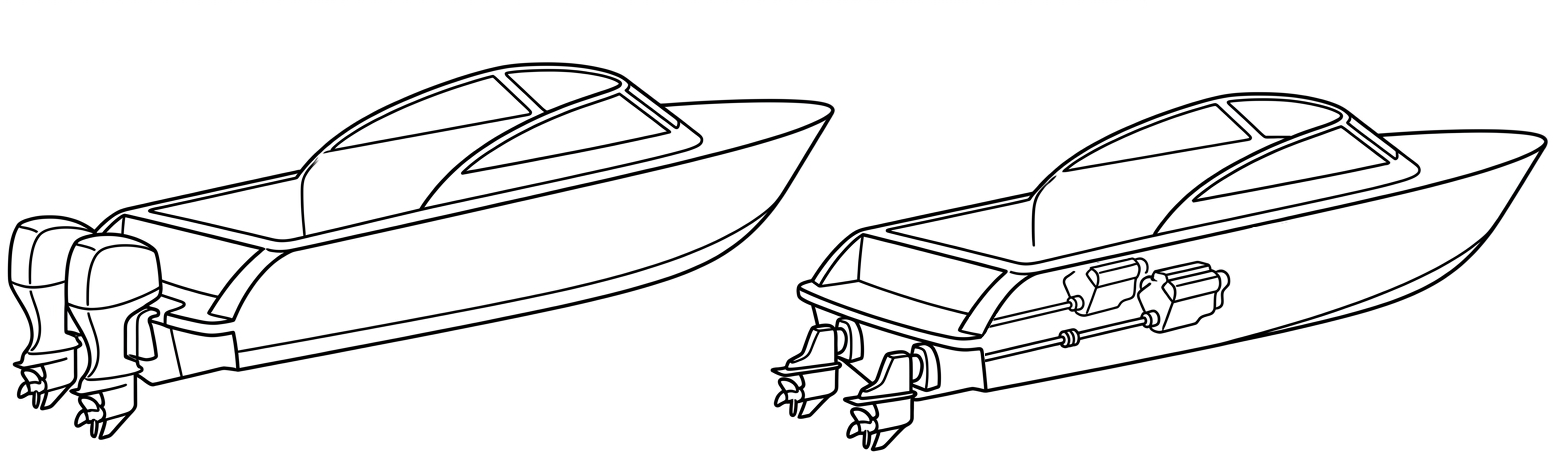
Inboards vs outboards
- Inboards often mean better weight distribution but they also take up valuable interior space. Servicing can be trickier if engine room is cramped, but the engines themselves are often easier to service because they are not as compact.
- Outboards are very accessible for servicing, but their entire weight ends up on the transom which also compromises the swim platform.
In practise, choosing between inboards and outboards largely depends on your preferred fuel, running gear, and hull type.
Type of fuel
- Petrol/gasoline is the most common fuel for outboard engines to make them lighter and improve throttle response. Petrol engines are usually less fuel-efficient than diesels, and inboard petrol engines require sufficient engine room ventilation (blowers) ahead of start to prevent risk of fire or explosion.
- Diesel typically provides better fuel consumption, but diesel engines are heavier and generally more expensive to buy. That said, diesel engines are widely considered safer and more reliable.
- Electric or hybrid propulsion is fairly new. Electric engines are considerably easier and cheaper to maintain, but they offer significantly less range. Batteries are heavy, although they can be placed for well-optimised weight distribution. Most common in hybrid systems for slow cruising or on sail boats for mooring and berthing.
Running gear
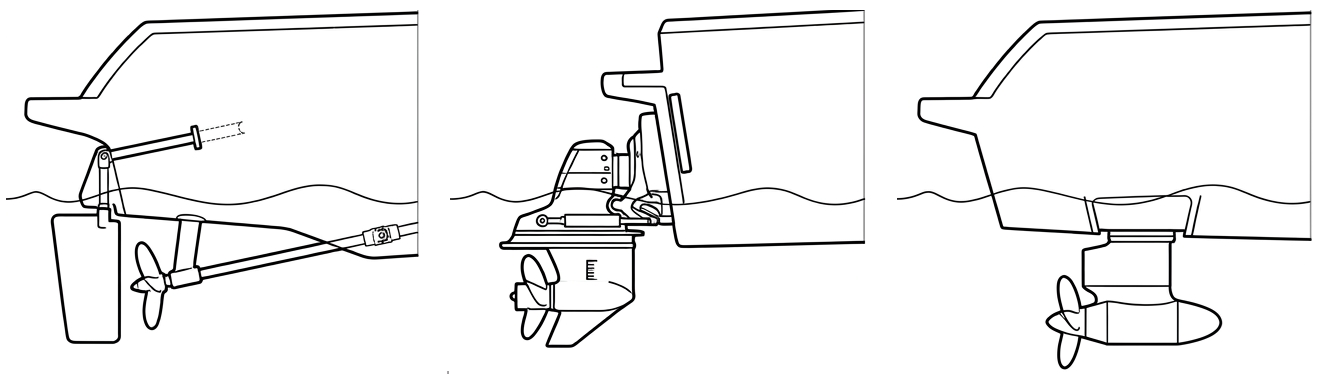
- Shafts are used in combination with rudders and provide the simplest, most reliable and least expensive running gear. This provides optimum course stability at slower speeds at the expense of manueverability, especially in close quarters.
- Stern drives offer better performance since they can be tilted for optimum propeller angle depending on speed, but they are more complicated and require considerably more maintenance. Offer more control in close quarters, especially while reversing.
- Pod drives offer maximum close-quarters maneuverability, commonly combined with joystick controls for 360 docking, but they are also the most complicated and expensive to maintain and repair. More fuel-efficient than stern drives, but still the most expensive option overall.
Superstructure
- Flybridge boats offer a lot of living space and versatility in changing weather conditions, but incrased windage makes berthing more difficult in strong crosswinds, and the increased air draught affects bridge clearance. Being relatively tall also means increased drag which in turn affects performance.
- Sedan boats offer better bridge clearance while still offering great protection in bad weather. Lower center of gravity may improve ride stability but you get less outdoor seating.
- Open boats are best for enjoying sunny days with maximum outdoor social space, but you are inevitably more exposed to the elements with greater dependency on canvas covers.

Windlass position
- Bow anchors make it easy to swing at an anchorage, or dock stern-to without a mooring line or buoy.
- Stern anchors are commonly used for bow-to mooring against a pontoon or cliffside, especially common in the Baltics.

Galley
- Gas stoves and ovens require little to no electricity, improving autonomy at anchor. However, they do require some care to remain perfectly safe and you will lose some space to the gas locker.
- Electric galleys often offer clever multi-purpose ovens (doubling as microwaves), but they require a generator or a substantial house battery bank and an inverter to support their massive power consumption.
Cooler vs warmer
- Air conditioning makes life onboard more comfortable in hot climates, especially at night for sleeping. However, they draw a lot of electricity and often require a generator to operate.
- Heating, commonly diesel-powered forced heating, makes life onboard more comfortable in colder climates. While many AC units can provide some heating, they are not nearly as effective as diesel heaters, meaning it's a common either-or decision for smaller vessels.
What should you choose then?
It comes down to how you use it. If you're primarily doing day trips in good weather, a fast open boat gives you the ability to quickly go somewhere and enjoy the sun with friends and family.
If you're crossing oceans or going on longer passages where it might not be an option to avoid bad weather, a stable displacement boat with a secondary wing engine might offer the right kind of security and range.
If you're primarily inland or in coastal waters, a semi-displacement hull might be the best compromise for enjoying slow-boating while retaining the option of speeding things up to get to your destination or safe anchorage before weather hits.
Why we chose the Swift Trawler 37
We (two adults, two kids) spend two weeks on board at a time during the summer, primarily in the Stockholm archipelago.
Swedish weather shifts quickly, making it ideal to have access to a flybridge when the sun is out, and then return below when it starts to drissle, without needing to put up or pull down canvas covers.
While it can get hot enough to make us want air conditioning in July, we are generally more in need of effective heating during spring and fall - sometimes during the summer month nights as well.
The Stockholm archipelago contains over 30,000 islands, meaning navigation is tight with lots to see. We prefer slow-boating and generally don't travel that far per day, although we sometimes want to speed things up a bit when going to a specific destination over the weekend.
That makes a semi-displacement hull with inboard diesel and shaft running gear perfect for us.
We wanted a reasonably sized boat for the typical guest harbor or anchorage in Stockholm while having enough living space and storage for extended stays on board.
While we considered the larger Swift Trawler 41 (now replaced by the Swift Trawler 43), we didn't feel the need for a third cabin or second head. Also, the single engine of the ST37 helps to keep costs manageable.